Over the last year I’ve started teaching a workshop called “What kind of loser indie publishes, and how can I be one too?” To put it mildly, there’s been a clamoring for the information. And, despite several good books on this topic already available, that clamor includes requests for a book from me. Said book
Sneak Peek! TOC & Chapter One of What kind of loser indie publishes?
Going Indie the Easy Way: Helen Colin, My Dream of Freedom
Do you have a story you’re burning to share, but no idea how to get from “once upon a time” to “buy now?” Helen Colin did. I want to share the experience of SkipJack’s newest author, how she did it, and how you can too. Helen is a 90-year old Holocaust survivor and beacon of
Pricing Advice for Indie Authors
One of the hardest choices to make as an indie author is how to price your books, at least it was (and is) for me. Why? Because it is so hard to see whether your pricing strategy is helping or hurting you amongst the many other variables that might be impacting sales. I’ve read tons
4 Ways To Use Public Speaking to Promote and Sell Your Indie Books
Many writers are, by nature, creatures that hide from the spotlight. I’m not above hibernating for weeks on end in my sleepy sheep pajamas. Yet those of us who publish need to spread the word about ourselves and books. Sure, we can use social media, but at some point, if you really want to gain
Sneak Peek! TOC & Chapter One of What kind of loser indie publishes?
Over the last year I’ve started teaching a workshop called “What kind of loser indie publishes, and how can I be one too?” To put it mildly, there’s been a clamoring for the information. And, despite several good books on this topic already available, that clamor includes requests for a book from me. Said book was already in the works, so, what the heck, here’s the unedited Chapter One of the book by the same name slated for August 2013 release. Following is its current Table of Contents.
Chapter One: You can make (no) money all by yourself.
My Personal Definition of a Loser:
- Willing to work hard to make little or nothing.
- Comfortable having people whisper “he couldn’t get a real book contract” behind his back.
- Under the right circumstances, would run naked on a beach.
Seriously, y’all, any writers out there? If you’re a writer, chances are you’re not in the game expecting a Spindletop gusher payday. Sure, it would be nice, but we all know most writers — most traditionally published authors — are working stiffs like the rest of us. For every J.K. Rowling, there’s a legion of also-rans, slodging away at day jobs they might not even like. English teachers. Air conditioner installers. Attorneys by day, like me, and night-and-weekend artists, like most of you reading this book.
For every traditionally-published author working a day job there are millions of writers who haven’t even grasped their hand around that solidly satisfying brass ring — true writers, writers called by their hearts to lay their souls or their wisdom on the page, yet writers who haven’t earned a single cent on a book sale, in any form of publishing. Maybe they’re already living the life, working as journalists, Hallmark card sonnet writers, or authors of jingles, dishwasher ads, and Viagra commercials.
The bulk of them aren’t summering in the Hamptons, either.
Have you ever met anyone who worked harder than a writer trying to make a living off writing alone? Me neither.
So why do we write, and why do we seek to publish, if it isn’t for a sure path to riches? I can’t speak for you, but I can repeat what writers around the country tell me. It’s the same thing that drives me, and it’s easy to sum up: we’re writers, and we can’t stop writing and dreaming of sharing our words with other people, any more than we can stop breathing in and out. We just can’t help it. Nor can we help dreaming that someone is going to come along to take the whole mucky, scary business of publishing off our hands, or at least make it very easy.
Because, make no mistake, while writing is an art, publishing is a business, a mucky scary business complete with supply chains, distribution networks, profit and loss statements, and inventory issues. It’s a business of relationships, contracts, and figuring out how to get the customer what she needs. It’s a business where, in essence, the decision of which books to publish usually hinges on whether or not they will be profitable; in other words, whether they will earn more money than it costs to put them into the customers’ hands.
It’s a business, like all businesses, that relies on the almighty dollar (or euro or deutschmark or whatever). Can we afford to keep the lights on and the doors open, or not? Can we pay our employees or not? Can we satisfy our owners that their money isn’t better spent elsewhere or not?
That doesn’t sound very artistic, does it? And it isn’t. No wonder many of us would love some publishing company to swoop in and take away the risk, the effort, and the sheer messiness of it all. Plus, gosh, doesn’t it mean you’re somebody special if a big publisher takes on your book? It’s legitimizing, at the very least.
But signing yourself and your art over to a publisher comes at a price. For all that help — valuable help — you give up a hefty piece of your future earnings, and a large measure of control as well. Make no mistake: you pay the publishing company to publish your book. They choose your book(s) because they think they can make money off of you, by providing those services and calling most of the shots, like what (if any) advertising, marketing, promotion, and publicity budget they will allot to your books. Like what your cover will look like. Like whether they’ll ever let your book see the light of day without the rewrites and edits they deem necessary for it to sell to the customer they are co-creating it for. Whether and what reviews they will seek for it, and what kind of weight they’ll put behind those requests. How they’ll promote it. When they will release it, and what other possibly competing books they’ll be handling as well. Shall I go on? I could, and it’s a pretty sobering list, considering you thought you’d come up sevens when the publisher bought the rights to your book(s). You mean it still might not get published? It might be published in a way that doesn’t maximize its chance of success, even if just in your eyes?
Shee-yut.
And working with a major house doesn’t guarantee your financial success. Herman Melville sold only 50 copies of Moby Dick before his death. In fact, most authors with major houses never “earn out” their advance, meaning they never get another cent after their initial advance check. The average debut novelist with a major house, according to Gary Smailes of The Proactive Writer (http://proactivewriter.com/blog/), sells about 2,000 books in the first year. If he sells 10,000 in the first year, chances are the house feels he is doing quite well. If he sells 14,000 or more in the debut year, the book will likely be deemed a big success to the house, but likely not earn the author much more than a pat on the back.
A few years ago, I stood at a crossroads in my own writing journey. I had multiple manuscripts for three of my novels out with great agents. I had their cell phone numbers on my iPhone. I didn’t have offers of representation, but I did have phone dialogues going and requests to see rewrites. I wasn’t there, but I was this close.
At the same time, the publishing industry stood at a crossroads of its own. Ebooks seemed poised to take over the world. Profit margins were tight. Major authors like Stephen King were discovering self-publishing (yeah, the authors the publishers made all their profit on). And it wasn’t just them. Amazon was offering 70% Kindle royalties. E-commerce was truly accessible, and print on demand had become almost easy. Gone were the days when a writer’s only alternative to traditional publishing was an expensive vanity press. Amanda Hocking had burst on the scene, making millions off books spurned by agents and editors. J.A. Konrath had shown that a middle-of-the-pack author could turn his released backlist and future indie published writing into a more-than-respectable income.
A steady stream of authors began making their way over to Amazon. Their dribs and drabs of sales added to the sales of self-publishing rock stars added up to something significant that the publishes felt in their wallets and in the deepest darkest scared places in their hearts. It didn’t, however, make much money for most self-published authors, who have trouble selling a copy outside of their immediate families. And 70% of nothing is, well, nothing. Or rather it is nothing in terms of money, but, if your goal is to share your words and your worlds, it’s a whole heck of a lot of something, and, to the major houses, all of that something started taking a bigger and bigger toll.
Publishers needed to figure out how all this change impacted their business model, but, frankly, at the time I was making my decision about whether to indie publish, they hadn’t yet. Writers discovered the concept of “disintermediation,” where the only truly necessary players in the game of book sales were author and reader, save possibly a freelance editor, a digital artist, a publicist, and a business consultant, and those were service providers an author could retain for herself, if she chose to.
Slim publishing profits narrowed further.
And I had a decision to make. Should I keep chasing after a possibility whose probability was rapidly decreasing, at the price of control? I mean, who really knew what return I would get on my three novel rewrites? Certainly I wasn’t guaranteed representation, and even if I got it, a book sale was not an automatic. If and when I signed a sales contract, the size of my potential advance shrunk daily, and the other terms of my deal grew less favorable as well, because this was business, and a business on the rocks. That potential deal would still require me to promote and market my own book too, on my dime and my own time. Bottom line: I had no guarantee of a return or of ever publishing.
Or should I throw my hat into the ring of indie publishing? Still, I’d have no guarantee of a return, and I could lose my own money at indie publishing. The rewards, though, were huge. I’d get the chance to share my words with whoever wanted to read them. I’d retain control, beautiful blessed control, and publish the book of my heart, not the book of someone else’s balance sheet. And that’s where the crux of it was to me: control. I’d been an entrepreneur for nearly 20 years. I knew how to run a business, and do it successfully. And promotion and marketing were a wash whether I went indie or stuck to tradition. How big a stretch was it, really, to move from entrepreneur to author-preneur? Bottom line: I had no guarantee of a return as an indie, but I did have a guarantee of publishing, which is what really drove me.
“You can make no money with someone telling you what to do or make no money calling your own shots. Which one would give you more joy?” my husband Eric asked. “And don’t answer that, because I already know. So I’ll help you.”
And he did.
I’d love to say the result was a gusher, but I’d be lying. It was a smashing success to us, while modest by major house standards. I sold 5,000 copies of my debut novel in the first six months. Combined with Kindle giveaways during that time period, 50,000 people got a copy of Saving Grace. It was picked up nationwide by Hastings Entertainment for their 137 stores, and regionally by Barnes and Noble. It led to greater exposure and sales for my backlist of relationship humor books. It paved the way for my future books. It beat the performance of most debut novelists with a major house. For all of that, I am grateful and excited, but not rolling in money. What I am rich in, however, is information, tons and tons of information on indie publishing successes and failures, good moves and missteps.
So here’s something I know: if you indie publish, you are a needle in a haystack. In 2012 alone, 235,000 indie titles were published, representing about 43% of books published that year, according to Bowker. There are more than one million Kindle ebooks in publication as I type this manuscript, and that number grows quickly. According to Penguin-owned Author Solutions (not my top choice for helping indie authors, but a valid source of data), its average indie title sells 150 copies. *That’s not an annual number, folks, that’s a forever number.*
Not only are individuals indie publishing, but so are businesses, like AskMen magazine, who has launched a line of books to meet perceived needs of their customers. Successful authors are turning their brands into franchises. Take James Patterson and his growing flock of authors, for example. So you’re competing with an incredible volume of titles, traditional and indie, individual and business, and it’s increasingly difficult to stand out from the crowd.
Be careful basing your “go indie” decision too heavily on widely-touted indie riches stories. For instance, Fifty Shades of Gray was originally indie-published, but it became a massive commercial success only after Random House picked it up (in my mind, it was still a huge indie coup that Random House discovered it in the realms of the indie published books, though).
Before you decide, ask yourself:
- Can I deliver the quality needed to make sales?
- Do I have the necessary business skills?
- Can I promote my books to the point of recognition and sales?
- Will I still have time to keep writing?
- And, most importantly, why am I choosing to indie publish? Because, if I only want copies of my book for myself, friends, and family, and I don’t care about making money, it may not matter to me if I ever sell a single book.
For some of us, despite the odds and the cons, our goals align with independence. If you’re one of those intrepid souls, stubborn to the bone and yearning to work like a pack mule, then you’re just the kind of loser who’s right for the world of indie publishing.
If that’s a “hell yeah” or even an “hmmm, maybe,” read on.
***
Table of Contents
Introduction: Getting your money’s worth from this book.
Part 1: Why the heck would you do this?
Chapter One; You can make (no) money all by yourself.
Chapter Two: It’s easier than it looks. And harder too.
Chapter Three: You’re gonna write it anyway, so why not do something with it?
Chapter Four: If it walks like a duck and quacks like a duck, it’s probably a platypus.
Chapter Five: Because loser is the new cool kid.
Part 2: Do yourself a favor and be the best loser you can be.
Chapter Six: It’s not easy being green.
Chapter Seven: You take the low road, and I’ll take the high road.
Chapter Eight: It’s not like anyone’s gonna know, right?
Chapter Nine: Because you’ve got to start somewhere.
Chapter Ten: Strategy is a sexy beast.
Chapter Eleven: The price is right.
Part 3: Avoiding the shape of an “L” on your forehead.
Chapter Twelve: Putting it out there.
Chapter Thirteen: The practice of writing, and writing as a practice.
Chapter Fourteen: If you don’t have anything nice to say, you’re perfect for a critique group.
Chapter Fifteen: Who died and made you the expert anyway?
Chapter Sixteen: Don’t go out with spinach in your teeth.
Chapter Seventeen: What the heck’s a beta, and why can’t you live without one?
Part 4: Making Sure You Look the Part
Chapter Eighteen: Image is (almost) everything.
Chapter Nineteen: Giving good copy.
Chapter Twenty: Pretend you’re a rocket scientist.
Chapter Twenty-one: Your name in lights.
Chapter Twenty-two: Tschotzes and hoohas rock.
Part 5: It always comes down to this.
Chapter Twenty-three: A plan unto itself.
Chapter Twenty-four: Help me help you.
Chapter Twenty-five: They won’t bite (hard).
Chapter Twenty-six: Who buys the cow when you give the milk away free?
Chapter Twenty-seven: It’s no contest.
Chapter Twenty-eight: Socialize for success.
Chapter Twenty-nine: Speak up, they can’t hear you.
Chapter Thirty: Book it, Danno.
Chapter Thirty-one: Becoming a media darling.
Chapter Thirty-two: And that was(n’t) all she wrote. (additional ideas, debunk advertising)
Part 6: Don’t stop now, you’re almost there.
Chapter Thirty-three: The line forms here.
Chapter Thirty-four: Ebook enhancing features.
Chapter Thirty-five: Pump up the volume.
Chapter Thirty-six: Oodles and poodles of fun.
Chapter Thirty-seven: The gift that keeps on giving, to Amazon.
Chapter Thirty-eight: Mistakes build character.
Chapter Thirty-nine: Your next big thing.
Chapter Forty: Stranger things have happened.
Chapter Forty-one: Someone else’s idea of hell can be your happy.
Bonus Materials
Indie Publishing Timeline and Budget Sheet
Marketing Plan for Saving Grace
Indie Army Promotional Spreadsheet
Publicist Paula Margulies’ interview of PFH
I didn’t get this smart by accident.
***
Over the course of this summer, I’ll share a few more select chapters on my favorite topics.
Until then, keep writing, my friends.
Pamela
Pamela Fagan Hutchins is an employment attorney and workplace investigator by day who writes award-winning and bestselling mysterious women’s fiction (Saving Grace) and relationship humor (How to Screw Up Your Kids) by night. She is passionate about great writing and smart author-preneurship. She also leaps medium-tall buildings in a single bound, if she gets a good running start.
Did you like this post? We help indie publishers skip all the jack. Sign up for updates. IT'S FREE!
Going Indie the Easy Way: Helen Colin, My Dream of Freedom
Do you have a story you’re burning to share, but no idea how to get from “once upon a time” to “buy now?” Helen Colin did. I want to share the experience of SkipJack’s newest author, how she did it, and how you can too.
Helen is a 90-year old Holocaust survivor and beacon of light, hope, and inspiration. Helen is not a writer. She is, however, a storyteller with an important message. Helen told her story to friends who helped her put it on paper. She had other friends to help her polish it as much as possible. But none of them knew how the heck to take Helen’s story any further.
Enter SkipJack. Helen read about me in a newspaper article, and the resourcefulness and determination that she drew upon to survive a Polish ghetto and Bergin-Belsen concentration camp did the rest. She picked up the phone, pitched my husband and publishing partner Eric for help, and we said yes and took it from there. Not only that, but we donated our services to her and convinced others to do so as well. Now she has a print book, an ebook, and an in-production audio book. She’s taken 50 copies to the Holocaust Museum of Houston for them to sell, and in two weeks on Amazon she’s sold six print books and ten ebooks. All proceeds go to the Museum. So, while there’s no landslide of financial success here (yet), it is still a huge success story, and would more than satisfy the dream of many authors. Wow, if only it were always that easy, right?

Unfortunately, it isn’t. But I can tell you exactly what we did and what it cost, and you can duplicate our steps to get to your own “buy now.” I’ll do the same with my road to publication as well. But let’s start with Helen.
First, we knew we needed a copy edit of Helen’s book. Editing is an absolutely mandatory step in the indie publishing process. Her book was in good shape and it was nonfiction, so we didn’t think it warranted a more rigorous manuscript consult/critique. I found a copyeditor for 1 cent a word, which is rock bottom pricing. I think I spent more time on it than the copyeditor, but we eventually got to a clean manuscript. Note: this was the only part of the project that was not done as a donation of time. For my own fiction, I spend 3-4 cents per word between manuscript consult and copyedit. I believe the result is worth it, and my sales support the cost.
Second, we needed a cover. A good cover sells books, a bad cover turns people away. My cover artist normally would charge about $500 for a cover like we envisioned, but she donated her time. We ended up with an attractive cover that met Helen’s expectations. For my own books, I spend about $750 on design for covers (print, ebook, and audio) and supporting promotional pieces. Covers will range from $250 up to $1500 or more. Because at her age Helen would not be able to get out and promote her book, we opted against promotional pieces at this time.
Third, we needed the manuscript formatted for print and ebook. Because this book is nonfiction and contains a great number of images, formatting was a little more time-consuming and difficult than for my fiction. I formatted Helen’s book and ebook myself. Because our strategy for Helen was to maximize simplicity and minimize cost, we planned to publish her only through CreateSpace/Amazon for print and Kindle/Amazon for ebook. This made things much easier for me! I used a CreateSpace template to format her book with a clean look in Word. I then converted that Word document into an ebook-ready format that I could upload directly to Kindle for conversion to an ebook file. They worked beautifully for our purposes. I do all my own formatting, so it is never something I spend money on, but if you hire someone to do it for you, each format can cost from $50 to $300 dollars, depending on the complexity of the book. Nonfiction is more complex and thus more expensive. I can format my own fiction quickly. A novel to print takes me an hour, and to ebook another hour.
For audio, we did a 50-50 royalty split with a voice over artist, so no money exchanged hands. Audio production will take another month or three. I did the same arrangement for my books, and I am quite happy with Audio Creation Exchange (ACX) for audio. We arranged for Helen’s eventual audio book to sell exclusively through ACX, Amazon, and iTunes to get her (and the Museum) the highest possible royalty.
We also chose to do KDP Select with Kindle, since we published exclusively on Amazon. This allows Kindle device owners who are Amazon Prime members to borrow Helen’s book for free, but Helen/the Museum to still receive a lending royalty. Also, we have the opportunity to help her do “free” days on KDP Select sometime in the future to build her readership and help her get reviews for her book. I have chosen to do the same for my books, and had a lot of success with it.
Helen had help (us) and the donation of services due to the charitable cause that is receiving all the proceeds from her book. You probably won’t. But you can do this indie publishing thing, too. It doesn’t have to be hard or even very expensive. If your dream is to see your book in print and allow others the opportunity to choose whether to buy it, you can get it from “once upon a time” to “buy now” spending as little as $250 for a good cover, 1-2 cents per word on a copy edit, and a few hundred dollars on formatting — less if you barter for some of the services. Crowdfunding is also an option to explore. Although I haven’t tried it, a friend of mine raised a few thousand to shoot a documentary using Indiegogo. If you chose the simplicity of the Amazon et al route, the steps are easy too. Or you can turn it over to someone and pay for their help in procuring these services for you (add in another few hundred dollars or a royalty share). If you decide you want to promote your book, the best promotion — you and your friends and family — costs nothing at all.
Yes, you can get much more strategic and spend money on promotion (I do: blog tour, publicist, book tour, etc.), but if your goals are modest, you can fulfill your dreams much more easily than you ever imagined.
While you wrestle with this information, might I suggest you go check out My Dream of Freedom, on Amazon, and leaving a review after you read it?
And if you’re in Houston August 28th, come to my workshop on how to indie publish, soup to nuts. It’s called “What kind of loser indie publishes, and how can I be one too?” Watch for more information about my workshops soon, here, and for a book of the same name by moi to be released in August 2013.
If you want me to do a workshop for your group via Skype or when I’m in your town on my book tour this summer of 2013, let me know. I speak on this and a variety of other topics. You can reach me at pamela@pamelahutchins.com, and keep reading SkipJack’s indie publishing blog for tips.
Good luck, y’all!
Pamela
Pamela Fagan Hutchins is an employment attorney and workplace investigator by day who writes award-winning and bestselling mysterious women’s fiction (Saving Grace) and relationship humor (How to Screw Up Your Kids) by night. She is passionate about great writing and smart author-preneurship. She also leaps medium-tall buildings in a single bound, if she gets a good running start.
Did you like this post? We help indie publishers skip all the jack. Sign up for updates. IT'S FREE!
Pricing Advice for Indie Authors
One of the hardest choices to make as an indie author is how to price your books, at least it was (and is) for me. Why? Because it is so hard to see whether your pricing strategy is helping or hurting you amongst the many other variables that might be impacting sales. I’ve read tons of advice from luminaries in the field, and most of it conflicts. Price your books at 99 cents. Price your books at their level of quality. Price your books to undercut major house but high enough to keep 70% margins.
I tried all of it, and I tried my best to figure out the correlation between the prices of my indie books and their sales. Here’s what I have for you as a result, after a year of experimentation.
First, my original strategy: I priced my print and ebooks too high. I wanted to send a message of quality, while still undercutting the major houses in acknowledgement that they had many layers of middlemen (and women) to be paid from their results.
For my print books, I priced my 40,000-word nonfiction books at $12.95 and my 83,000-word debut “women’s fiction mystery” (my own made-up genre, which is your prerogative in indie publishing) novel at $18.95. My thinking was that I wanted to leave room for a decent margin for myself and for booksellers, as we not only do consignment at SkipJack Publishing, but we also have chain distribution through Hastings Entertainment at its 130+ stores nationwide, and regional chain distribution with Barnes & Noble. We publish on both CreateSpace/Amazon and on Lightning Source/Ingram for print on demand (LSI gets us in with the brick and mortar stores, CS is optimal for Amazon sales).
To get specific, this left me a margin of about $3 per book through distribution on LSI and of $4 to $5 per book through CS. Those are great margins, as long as you can achieve volume.
Here’s where attributing correlation is difficult. My sales were really pretty darn good for an indie, especially at brick and mortar stores. However, we felt like our assertive promotion and marketing strategy pushed people into the stores who were primed to buy. We did not feel like we were getting the “browser” buyer who was looking for cheaper books.
So we changed strategy for print book pricing, and we’ll see in six months how that works out for us. We’ve moved or prices down to the point where our margins on our print books will be $2 on CS and $1 on LSI. Specifically, we reduced our nonfiction to $10.95 and our seasoned fiction to $12.95. We still plan to debut novels at a minimum of $14.95. However, in e-commerce, all of the books will now be less than $10. It’s our educated guess that $10 is an important price point online. The prices will be over $10 in bookstores, but we can’t do anything about that with print on demand (if someone knows differently, I’m all ears) because our print cost won’t allow us to break even, otherwise.
We are watching for a significant impact on the volume of print books sales. Wish us luck!
For my ebooks, I priced my 40,000-word nonfiction books at $3.99 and my 83,000-word debut “women’s fiction mystery” at $7.99. It was quickly clear that, even with an uber-successful KDP Select Free run at number one and 33,000+ downloads (and the resulting time I spent after on the bestsellers rankings), $7.99 was too much for debut indie fiction. I marked it down to $5.99. Then $4.99. Finally, $3.99. And I think at $3.99 I’ve found the right cost for our strategy, which is to earn the 70% Amazon margin and take a stand on quality. I think $2.99 or $3.99 is good pricing for this strategy, depending on the length of your book and genre. When my new novel comes out, however, I’ll price the old release at 99 cents, and I’ll price the 2nd book/new release at $3.99. This way I can work both volume and quality strategies at once.
The nonfiction, while never high volume sellers, seemed less impacted by price than the novel. Their sales seemed steady whether I priced them at $3.99, $2.99, or $1.99, all of which I tried. I ultimately settled on $2.99, mostly because they are half the length of my fiction. I will be leaving them at this price.
One concern we have is that our ebook pricing not be so low that it negatively impacts brick and mortar book sellers. This is the other key factor (in addition to pricing at a perceived “quality” price and taking advantage of 70% royalties) that led us to stick with $3.99 for the novel. While it is still significantly less than the print book price, it’s not a “steal,” and, for people that prefer print, they can still justify spending more. We find that there is a real divide between those that prefer print versus those that prefer ebook, although of course there are those in the middle who buy both. If you’re not worrying about brick and mortar stores, you may be more inclined to pursue the 99 cent strategy.
A few additional things to keep in mind: Amazon will always match the lowest price on the web, so be careful. Also, this price matching results in some complex strategy when you’re publishing print on demand on both CS and LSI. For a good article on this, click here.
Stay tuned over the next six months as we toggle our prices further and share the results, especially as we look to see what impact our 60-city Saving Grace summer book tour and the release of my next book in the Katie & Annalise series and my (shh, don’t tell yet) book on indie publishing will have on sales.
Good luck!
Pamela
Pamela Fagan Hutchins is an employment attorney and workplace investigator by day who writes award-winning and bestselling mysterious women’s fiction (Saving Grace) and relationship humor (How to Screw Up Your Kids) by night. She also leaps medium-tall buildings in a single bound, if she gets a good running start.
Did you like this post? We help indie publishers skip all the jack. Sign up for updates. IT'S FREE!
Five Tips For Indie Authors on Goodreads
If you’re an indie author and you’re not on Goodreads, it’s time to take the plunge. With a rapidly-growing community of readers and authors numbering over 10 million — thanks to integration with Facebook timeline — and a data partnership with industry giant Ingram, Goodreads is the leading social media site for bookophiles. We congregate to swap book recommendations and reviews, interact in like-minded groups and clubs, and even to win swag from authors themselves. Goodreads has competitors, like LibraryThing and Amazon’s Shelfari, but they pale in comparison to the dominant hold Goodreads has on this space.
For many overwhelmed, overworked, and underpaid authors, the thought of another social media site (or any social media site) may send you into the tremors. Goodreads makes it easy, though, starting with their Author How-To. The How-To has slide shows to guide you step-by-step through creating your author profile, and much, much more. In fact, they teach you how to do just about everything I’m going to recommend.
Before I start with the tips though, it is important to understand that I chose them because I think they have the greatest likelihood of driving user engagement with you, the author, with the ultimate goal being that users read, rate, and review your books, thus driving other users to engage with you in the same way. The more people add your books to their shelves, rate, and review your books, the more other readers will be influenced through notifications of those actions in their Goodreads feed to do the same thing.
So here are the tips:
1. Create a dynamic author profile
Yeah, yeah, you’ve done this before and it’s called a website. I know. But none of the 10 million+ Goodreads users want to leave Goodreads, which, for them, is one-stop shopping. In fact, the only time they leave will be to buy your book, so take advantage of all the bells and whistles Goodreads lets you add to your profile, and engage your community. Do the expected things well: an interesting profile, a quality photo, making sure all your books are linked to your profile. Tzotchkes to keep users coming time and again? Add your blog feed. To engage them with you directly? People love videos. To show them you’re for real? Add your events, like signings, readings, seminars, and releases. You can even browse through your friend list and let friends know specifically of your events in their area. I’ve done just about everything Goodreads offers, so feel free to steal ideas from my profile.
2. Shelve, rate, and review books
Goodreads is a reader community, so share what you’re reading. You can put books on your “to-read” shelf, and, when you’re done, you can rate and even review them. HINT: You can copy and paste the same review onto Amazon (or vice versa) as well. Take the time to search for and rate/review your favorite books too. Building your ratings lists teaches Goodreads how to recommend books to you, and your biggest fans will love seeing what you think of other literature. Bonus: CREATE a shelf of your Influences or Favorites, and add the books by authors who influenced your own writing. Note: Goodreads lets you rate/review your own books. Rating is generally OK, reviewing….well, not so much.
3. Add Goodreads widgets to your own website
Goodreads allows you to generate widgets that you can put on your own website, to suggest to website visitors that they add your books, rate, and review them on Goodreads. Here’s an example from my nonfiction book page. Even better is the widget that streams reviews from Goodreads to your website. Check this example out (scroll down to the middle of the page) to see how well this feature can work for you. Also, note the widget in the right hand column that shows all the author’s books and their ratings on Goodreads. Sweet! Now you’re using the good results from Goodreads to influence web visitors that may not even be Goodreads users themselves.
4. Run giveaways on your own books
Over 40,000 users per day participate in giveaways on Goodreads. Run giveaways on your own books and readers are much more likely to notice, add, read, rate, and review your book. The most likely persons to do these things are the winners themselves, so give away as many books as you can. I gave away 12 of Saving Grace, and I think that my giveaways were largely responsible for getting it added to over 1130 shelves to read, and generated a number of ratings and reviews as well. My goal is to get my ratings over 100 before I release the next book in the series, so I may do a few more Giveaways.
5. Join groups (or interact with lists) and participate
Goodreads features more than 20,000 book clubs, each of them with unique members and rules. Keeping in mind that Goodreads is a reader community, join some groups, familiarize yourself with the rules, and start chatting with other readers about books…any books but your books. Over time, as you become a contributing member of that group, you can approach the moderator to ask for a facilitated discussion of one of your books, but please make that transition a natural and not forced one (otherwise you’re giving all of us authors a bad name as pushy used car salesmen). Bonus: you can even create a group for discussion of your own book, complete with videos and polls for optimal user engagement.
Lists work much the same way, and there is a list for every topic imaginable on Goodreads. My recent favorite? Right here. Check out the books in the top 25 or so. You will see names you recognize!
How does all this translate to book sales? It’s really impossible to quantify. But if you look at the books that are selling on Amazon (or in bookstores) , their user engagement on Goodreads is quite high, which suggesst correlation, at least, if not causation. Causation comes from you — your actions and your book. I believe that you will be hard-pressed to find a social media site better targeted at exactly the community you want to be exercising your causation with
. And all of it costing exactly nothing but your time.
Good tips. Goodreads. Good luck.
Pamela
Pamela Fagan Hutchins is an employment attorney and workplace investigator by day who writes award-winning and bestselling mysterious women’s fiction (Saving Grace) and relationship humor (How to Screw Up Your Kids) by night. She also leaps medium-tall buildings in a single bound, if she gets a good running start.
Did you like this post? We help indie publishers skip all the jack. Sign up for updates. IT'S FREE!
4 Ways To Use Public Speaking to Promote and Sell Your Indie Books
Many writers are, by nature, creatures that hide from the spotlight. I’m not above hibernating for weeks on end in my sleepy sheep pajamas. Yet those of us who publish need to spread the word about ourselves and books. Sure, we can use social media, but at some point, if you really want to gain exposure, you have to interact with “real” humans. Even if you hire a publicist, he or she will not be able to get much traction for you unless you’re willing to do book events and public speaking. Forget media — you need to sell books, speak, and do events to get their attention, plus — oops — they’re humans, too.
So let’s talk about human interaction, speaking in particular (I cover book events in other posts). Most successful authors agree that speaking is a heck of a great way to promote and sell books. I sell books at every speaking engagement I book. That’s pretty good incentive to do it, yet the mere thought terrifies most people, let alone an introverted writer. I can’t help you with your fears (try “Talk Up Your Book” for that), except maybe your fear of what to speak on, to whom, and how to do it.
1) Do you write nonfiction? Pitch a topic related to your book to groups who share an interest. Maybe you write about remodeling old houses – contact historical societies. Google is your friend. I write on, amongst other things, ADHD and Autism-spectrum parenting, so I do a topic called “Everyone blames the mother” for special needs parenting groups.
2) Do you write fiction? Parse out a subject or location from your book. Say you write American revolutionary historical fiction — pitch it to the Daughters of the American Revolution (yep, Google). I write women’s fiction mysteries set in the Caribbean, and I speak on living and traveling in the Caribbean to travel groups.
3) Maybe you have an interesting day job? I share stories about workplace investigations, to writers groups and to book clubs. To find them, I use not only google, but Goodreads. Who wouldn’t want to come to something called “Colonel Mustard in the Conference Room With His Pants Down,” after all.
4) And any of you are qualified to speak on writing and indie publishing, to writers groups or meetings. I have writer friends that teach agent pitches, synopsis writing, creative writing, the writing practice, and many other topics. I do one called “What kind of idiot indie publishes, and how can I be one too?” Your local writers group is a great place to start, but, again, google opens all doors.
Each time I speak — whether at a private location, a library, or a bookstore — I sell books. How many? Depends on the size of the group, but usually about 10. I take my entire backlist, no matter what I speak on, and for whom, although sometimes the topic really dictates the bulk of what I sell at each gig.
Logistically, here’s a checklist for speaking:
- Plan what you are going to talk about and prepare your speaking notes and any visuals or handouts you plan to use.
- Secure permission from your contact to bring/sell books.
- Pack a wheeled suitcase with your supplies: books, signing pen, paper to record email addresses of readers who want to stay in touch, and giveaway items (I always bring bookmarks and business cards).
- Be sure you are prepared to take cash (and give change), check, or charge. I recommend selling your books for a number ending in a 0 or 5, for ease of making change. Do you an iPad or iPhone? Try out Square Register. It’s a cheap and easy way to turn your phone into a cash register which accepts credit card swipes.
- Ask your contact for a small table to display your wares.
- Bring a buddy if you can, to help with logistics and your first-time nerves.
Personally, I think I’ve only begun to scratch the surface of the opportunities for speaking as a way to promote and sell my books. Who knows how many I can sell if I expand my speaking. I definitely know how many I’ll sell if I sit at home. One of these numbers is bigger than the other, and I’ll leave it to you to guess which one.
Pamela is an employment attorney and workplace investigator by day who writes award-winning and bestselling mysterious women’s fiction (Saving Grace) and relationship humor (How to Screw Up Your Kids) by night. She also leaps medium-tall buildings in a single bound, if she gets a good running start.
Did you like this post? We help indie publishers skip all the jack. Sign up for updates. IT'S FREE!
Where have all the SkipJack posts gone?
Greetings, long-neglected followers of the SkipJack Indie Publishing blog. Life got pretty damn busy for Eric and Pamela in the last three months, and all our promised posts just didn’t happen.
Sigh…
Does it matter that it was a good kind of busy? That Saving Grace is now in all 140 of Hasting Entertainment’s stores, nationwide? That Barnes & Noble’s Small Press Department picked up Saving Grace and stocked it regionally, with an ever expanding roster of stores? That we are publishing a new author in May, with a wrenching — and, dare we say, important — Holocaust memoir? That we’ve moved into audio books, are planning a national book tour for Pamela this summer, and are in pre-release mode for the highly-anticipated second installment in the Katie & Annalise series, Leaving Annalise?
We didn’t think so.
So here’s our promise to you. We’re going to get back to our twice-a-month publication schedule, and you can look for these topics in your inbox, soon:
- Audiobooks for the Indie Author: On the Cheap, and Easy as Pie
- Pricing Strategy for Indie Authors
- What Can A Blog Tour Do For an Indie Author?
- Does an Indie Author Need a Publicist?
- How Can Goodreads Help An Indie Author?
- Connecting Indie Authors with Book Clubs
- Putting Together an Indie Author Marketing Plan
- Public Speaking and Promotion of Indie Books
- And many more!
Sorry for our absence!
Eric and Pamela
Did you like this post? We help indie publishers skip all the jack. Sign up for updates. IT'S FREE!
Gift Card Giveaway: You can be a winner.
Books make great gifts, and we’d like to help you give them this holiday season. We are giving away two gift cards for $25 each to Hastings Entertainment. They can be used online or at one of their 140 stores.
Enter and share the contest below, and Merry Christmas from SkipJack Publishing.
a Rafflecopter giveaway
Did you like this post? We help indie publishers skip all the jack. Sign up for updates. IT'S FREE!
Interesting, and not in a good way: sales crash post KDP Select.
The latest tale in the saga of our indie publishing is a tragedy, not a triumph. We plan to turn it around, and you’ll get a ring side seat, but here’s the scoop for now.
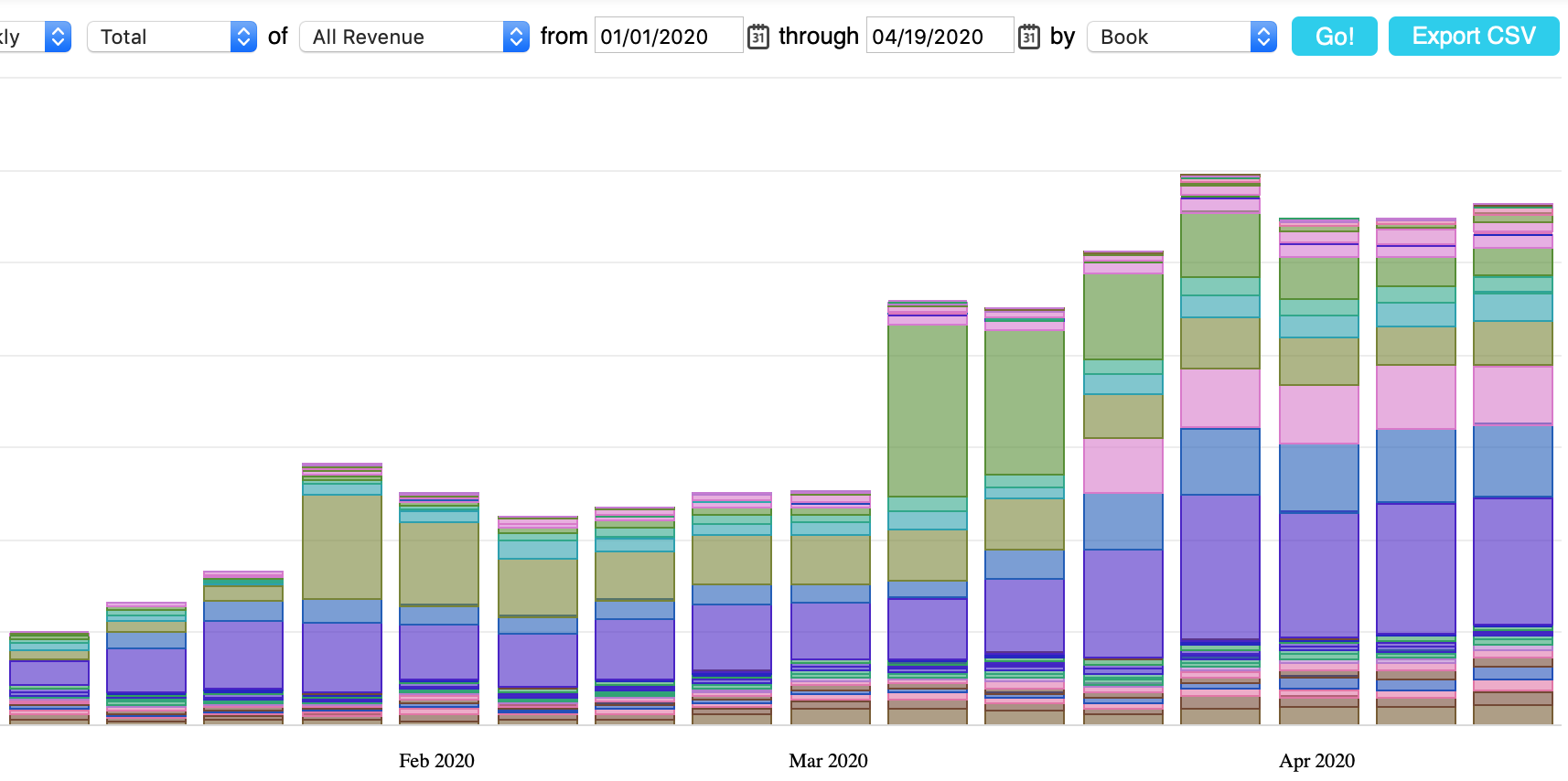
Some of you may recall that we had a tremendous run on KDP Select with Saving Grace, first as a free promo in late October and then as a best selling ebook. It was so great in November that we want to tell you about the numbers that month, the months leading up to November, and the first few days of December. It helps to show you all sources of income aggregated for all books, so here’s how it looks (click to see it all):
Part of the benefit of KDP Select is that Amazon allows its Prime members to borrow your ebook as part of their membership at no additional charge to the member, and Amazon pays the participating books/authors/publishers their share of a pool of designated funds each month based on their percentage of overall member borrows.
Note that in October, with the pre-launch of Saving Grace, income was up. Then we ran all my books into KDP Select, and Saving Grace in the free promo. We did 33,000+ downloads in the promo.
In November, total income was way up. Including and especially on Kindle, where we had Saving Grace priced first at $4.99 then at $3.99 (separate post someday in the future on pricing strategy– it’s important and too detailed to address here). It also became a bestseller for most of the month. We priced the other five books at $2.99. In October, we made $2.36 per borrow, and we estimated the same amount per borrow for November.
All in all, since my first book only came out in May 2012, we were really happy with nearly $4500 in royalties for November. Note: actual sales $$ are much higher of course, but there is a cost of goods sold element which royalties are net of. There are also additional expenses, both before and after publication, but this isn’t a post on running an indie publishing business. I’ll write that at a later date, possibly a “first year retrospective” that includes profit/loss and costs. Suffice it to say we were elated with the numbers.
Then we got some bad news. Smashwords, with whom we had previously listed Saving Grace, had tried repeatedly on our behalf to get Apple to pull it down so that we could do KDP Select exclusively, as required. Apple did not comply. KDP Select booted Saving Grace.
We gnashed our teeth and sought advice and decided that with our upcoming marketing and promotional blitz plans for mid-December 2012 through March 2013 (online ads, publicist, and paid blog tour), that fate had spoken and we were better off available through all possible outlets, foregoing the $2.36/book borrow fee through KDP Select. {Huge sigh.} We hope this decision is right in the long run. For December, it looks awful. We sold 19 Kindles of Saving Grace per day in November, and we are down to 3/day in December. We did 35 borrows per day in November, and there are none and will be none for December. The other five books are still under exclusive for KDP Select. We re-enrolled Saving Grace with PubIt (Barnes & Noble) and Smashwords, and we enrolled it in Omnilit and Kobo. So far, zippo under any of them.
So, the promo and marketing are about to kick off, with the biggest surge unfortunately not until January. We are hopeful that we will regain some mojo in December, but without the exponential impact of rankings and KDP Select promo we are at a disadvantage just when the sales opportunity is best. Big fat freakin’ bummer.
I will say that the fantastic reviews continue to pour in, and are up from 19 to 71 from pre- to post-free promo on KDP Select. We’ve also experimented with a giveaway on Goodreads to increase the number of ratings there and it has taken it from 17 to 45 in three weeks. I hope this continues.
I am not a big fan of Amazon, the company. I hate their review policy, although I won’t rehash it here. I do recognize what they did for us as an indie author and indie publishing company through KDP Select, though, and I am hoping that we don’t live to regret our decision to accept Apple’s foot dragging as fate.
I’ll update you as updates become available.
Pamela
Did you like this post? We help indie publishers skip all the jack. Sign up for updates. IT'S FREE!
It’s No Contest
I don’t keep it much of a secret that I am a big fan of writing contests. As Garrett Morris used to say on Saturday Night Live, “Contests been veddy veddy good to me.” Or something like that, anyway.
So the question isn’t whether I’m a contest proponent, but why. Let me explain the whys, and, if I convince you of their merit, stick around for a few whens, wheres, and hows.
WHY
1. Many contests provide a critique sheet. Before you publish that book, you need unbiased critical feedback. How good is your critique group? Can they really be unbiased? The contest critiquer can, and the critical analysis of your manuscript and its relative position against other contest entries is worth the price of admission, even if you don’t win. Of course, you should ask whether a critique of your submission is included before you enter, as not all of them provide critique sheets.
2. Many contests suffer from too few entries. Few have the opposite problem. So your chances to win, place, or show may be greater than you think.
3. Contests help a writer get over fear of submission/publication. Yegads, you mean I have to let someone else read my work and espouse their opinion????? Jump in, the water’s fine.
4. Judges may be agents or editors. Yes, this could be your big break. It probably won’t be, but you’ve got a better chance than all the other schmucks who don’t submit.
5. You could win. Contest wins give your book credibility. They give you fodder for a press release. They help you sell books.
WHEN
Don’t enter a book that isn’t finished. Don’t enter a book that isn’t ready for submission.
Are you still with me? Good. Let’s talk about how to find a contest, and which ones you should enter.
WHERE
Local, regional, genre, and national writing groups and conferences often hold annual competitions. Start in your region and genre by perusing websites and/or newsletters.
Looking for someone to do the heavy lifting for you? Here are a few good sources for contest lists, but none are comprehensive:
Just google “writing contests” and the genre and year. You’ll get lots of choices. Pick contests that fit your work, of course, and don’t be afraid to email the organizer and ask about number of entries anticipated. If your writing is not yet contest-tested, start small and work your way up to bigger competitions.
HOW
Most contests list confusing explicit instructions. Expect that your entry may include any of the following:
1. Entry fee: The higher the award, the higher the fee. Expect around $50. Often you get a discount on multiple entries.
2. Excerpt: Most contests want only your first X pages or X words, not your whole manuscript, but some want it all. Many require it to be snail mailed, many don’t. Just follow the instructions to the T. They may differ from how your work is currently formatted.
3. Synopsis: A synopsis is generally required and graded. It needs to be compellingly written and match the book in voice/tone. The length will vary, but, again, follow the instructions.
You ain’t gonna win if you lose points for not following instructions, even instructions that don’t seem logical. FOLLOW THE DANG INSTRUCTIONS, Y’ALL. Been there, lost points (and a contest) on that.
Just for grins, I uploaded a critique sheets from one of my contest wins to give you a flavor for the elements analyzed and the type of feedback given. This will vary by contest, of course.
Nothing ventured, nothing gained, so venture forth my friends, and contest, contest, contest.
Pamela Fagan Hutchins
Did you like this post? We help indie publishers skip all the jack. Sign up for updates. IT'S FREE!
Happy Thanksgiving!
From us, to you: We are grateful for this opportunity to explore the brave new world of indie publishing today, and to share it with you.
We’ll be back next week with more of our hard-won experience.
Until then, Happy (American) Thanksgiving!
Eric
Did you like this post? We help indie publishers skip all the jack. Sign up for updates. IT'S FREE!